
How to Choose a UV Coating Curing Machine?

Choosing a Uv Coating Curing Machine is not just a matter of comparing lamp power or conveyor speed. The right system must match the coating chemistry, substrate, line width, and production pace. A thin varnish on a flat carton may cure differently from a heavier coating on a heat-sensitive plastic sheet. Small differences matter.

A practical principle for this guide, expressed in the voice of a fictional process specialist, Alex Morgan: “Choose for the coating and substrate you actually run, not the machine specification that looks strongest on paper.” This is an editorially created quote, not a statement from a verified industry expert. It points to a common purchasing risk: a powerful lamp cannot compensate for poor process matching.

The sections ahead will examine UV source type, curing width, conveyor controls, cooling, maintenance access, and supplier support. Ask for test results using your own coating and material. Check whether the finish remains tack-free, adheres well, and tolerates the next production step. Look closely at the edges. A glossy surface can still hide uneven curing.

There is no perfect specification. Production conditions change, and supplier claims deserve practical testing. A careful trial may take longer than expected. It is still worth doing.
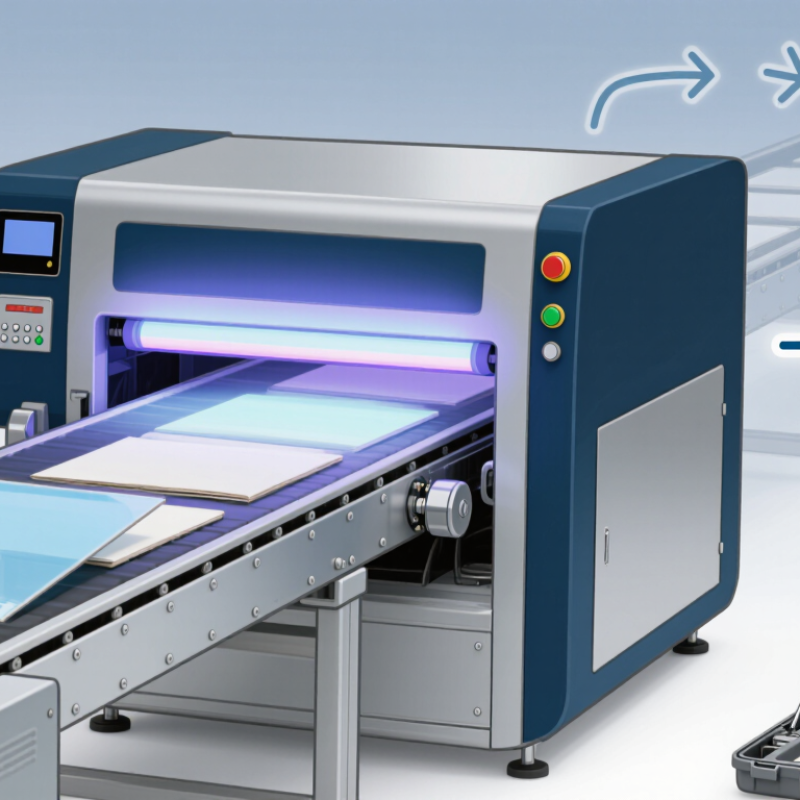
How to Choose a UV Coating Curing Machine?

Identify the Coating, Substrate, and Production Requirements

How to Choose a UV Coating Curing Machine?

Start with the coating, not the machine. Check its technical data for the UV wavelength range, required dose, and recommended exposure time. A coating that feels dry may still be undercured beneath the surface. Ask the supplier for test conditions, then verify them on your own line. Small differences matter.

Next, consider the substrate. Paper, plastic film, wood, and metal reflect and absorb UV light differently. A glossy plastic sheet may heat up quickly, while a textured wooden panel can leave shadows in recessed areas. Test a representative sample, including its thickest or most detailed section. Watch for poor adhesion, surface tack, discoloration, or warping. Not every test will be clean.

Production speed shapes the choice, too. Note the line speed, working width, shift length, and space available around the conveyor. The curing unit must deliver enough energy at the actual operating speed, not just in a showroom test. Consider ventilation, cooling, lamp maintenance, and how easily operators can monitor output. A rushed trial can miss defects. Keep records of settings and results; they make later adjustments more reliable.

Match the UV Light Source to the Coating’s Curing Needs

Match the lamp to the coating’s photoinitiator, not just the machine’s advertised power. UV coatings respond to specific wavelengths; many UV-LED systems emit in narrow bands around 365, 385, 395, or 405 nm, while mercury lamps provide a broader spectrum. The U.S. Department of Energy’s 2022 Solid-State Lighting R&D Opportunities report describes LEDs as narrow-band sources, a distinction that matters when a coating’s initiator cannot absorb the lamp’s output. Check the coating supplier’s wavelength guidance, then verify it against the machine’s measured spectrum. A label saying “high intensity” is not enough.

Next, consider film thickness, line speed, and heat sensitivity. Shorter wavelengths may cure the surface while leaving deeper layers under-cured; thicker or pigmented coatings can make this more likely. Ask for irradiance and dose measurements at the actual working distance, not only at the lamp window. RadTech’s UV/EB technology guidance also emphasizes matching process conditions to the formulation. Test a real coated sample, then inspect the surface and adhesion after curing. It takes a little time. But a tack-free surface can still hide a weak cure, and I have seen that assumption waste production runs. Check the substrate temperature, too; some materials warp before the coating looks wrong.

Compare Machine Types, Capacity, and Process Controls

How to Choose a UV Coating Curing Machine?

Compare Machine Types, Capacity, and Process Controls

Choose the curing method around the coating and production line, not just the machine’s rated power. Mercury-vapor lamps deliver broad-spectrum output and suit many established coatings. UV-LED systems provide narrower wavelengths, lower heat exposure, and instant switching, but only work well when the coating responds to their spectrum. Check the supplier’s measured irradiance and dose at the actual conveyor speed. A glossy test coupon proves little if a shadowed edge stays tacky. Small detail, big consequence.

Capacity means more than conveyor width. Match working width, line speed, and lamp coverage to the widest substrate you run. Ask for dose readings across the belt, including its center and edges, at both minimum and maximum speeds. MarketsandMarkets estimated the global UV-curable resins market at USD 5.3 billion in 2023, projecting USD 8.3 billion by 2028. This market estimate signals expanding use, but it does not guarantee that every coating or machine combination will perform reliably.

Process controls help make results repeatable. Look for adjustable power, speed interlocks, lamp-hour tracking, cooling alarms, and recorded process settings. For LED units, confirm wavelength compatibility; for mercury lamps, check cooling and reflector maintenance needs. Test your own coated material under production conditions, then inspect adhesion, gloss, and cure depth. A simple radiometer can reveal output drift before defects spread. Controls can still be mis-set, and operators need clear procedures. That part is easy to overlook.

How to Choose a UV Coating Curing Machine? - Compare Machine Types, Capacity, and Process Controls

Compare common UV curing machine configurations by typical use, throughput factors, and available process controls. Capacity and curing results depend on the coating, substrate, lamp configuration, and production settings; confirm requirements with curing trials.

Machine type Typical applications Capacity considerations Common process controls Key advantages Points to evaluate
Conveyorized UV system with mercury-vapor lamps Continuous coating, printing, and finishing lines; compatible UV formulations Throughput is primarily affected by conveyor speed, usable belt width, lamp power, and the number of curing zones. Belt-speed adjustment, lamp power settings, exhaust or cooling monitoring, and optional UV-dose measurement Suitable for continuous production and a broad range of conventional UV-curable materials Requires attention to heat-sensitive substrates, lamp maintenance, ventilation, and compatible coating chemistry
Conveyorized UV LED system Production lines using coatings formulated for the LED emission wavelength Depends on LED irradiance, illuminated width, exposure time, lamp-to-part distance, and line speed. LED output level, conveyor speed, temperature monitoring, and optional irradiance or dose verification Instant on/off operation and generally lower infrared heat output than conventional mercury-vapor lamps Confirm that the photoinitiator system responds to the LED wavelength and that the required dose reaches the full coating layer
Batch UV curing chamber Small or varied production runs, parts that do not suit a conveyor, and laboratory or job-shop work Batch size is limited by chamber dimensions, loading arrangement, lamp placement, and the need for even exposure. Cycle timer, lamp power, interlocked door, cooling or exhaust monitoring, and recipe selection on some systems Flexible for different part shapes and production quantities; does not require a continuous line Check for shadowing, consistent part positioning, chamber ventilation, and repeatable loading procedures
UV flood-curing system Flat panels, printed sheets, and multiple small parts presented together Effective area and exposure time determine practical output; uniformity across the illuminated area should be verified. Exposure timer, lamp intensity or power adjustment, work distance, and optional dose measurement Can expose a broad area at once and accommodate items that are awkward to convey Evaluate edge-to-center dose uniformity and whether parts need rotation or more than one exposure
Spot or focused UV curing system Localized curing, small coated areas, assembly work, and precision applications Output depends on spot size, irradiance at the work surface, exposure duration, and positioning accuracy. Exposure timer, intensity setting, optical-head positioning, and optional foot-switch or automated triggering Targets a limited area and can be integrated into manual or automated workstations Not intended for broad-area curing; confirm spot coverage and avoid uneven results at the edges of the cured area

Selection checklist

Requirement What to confirm before purchase
Coating compatibility Confirm the coating’s required UV wavelength range and curing dose with its technical data sheet or supplier.
Production rate Estimate required parts per hour, exposure time, changeover time, and loading or unloading time.
Part size and geometry Check usable curing area, clearance, part orientation, and whether recessed or shadowed surfaces need additional exposure.
Process verification Ask how lamp output and delivered UV dose can be checked, recorded, and repeated during production.
Safety and facility needs Review UV shielding, safety interlocks, ventilation, heat management, electrical supply, and maintenance access.

Capacity figures should be established through trials using the actual coating, substrate, part geometry, and target cure criteria. UV dose is commonly expressed in mJ/cm², while irradiance is commonly expressed in W/cm² or mW/cm².

Check Installation, Safety, and Compatibility with Existing Equipment

How to Choose a UV Coating Curing Machine?

Check the installation area before comparing lamp power. Measure the conveyor, service clearance, ceiling height, and distance to nearby heat-sensitive materials. Confirm the machine’s voltage, phase, and peak power draw against your electrical panel. Ask the supplier for ventilation and cooling requirements; a compact unit can still need substantial exhaust capacity. Record your existing line speed and coating width, then check that the proposed curing window matches both. Small mismatches matter.

Safety needs practical checks, not just a checkbox. The International Commission on Non-Ionizing Radiation Protection (ICNIRP) sets an actinic UV exposure limit of 30 J/m² over an eight-hour period. Use that benchmark when assessing shielding, interlocks, and operator access. Request measured irradiance data at the working distance, and verify that doors stop emission when opened. Also check lamp replacement procedures and cooling-down time. These details are easy to overlook.

Tips: Bring photos and equipment dimensions to the site review. Ask for a trial using your actual coating and substrate. Compare cure results at your target line speed, and inspect the edges for tackiness. I’ve seen a technically suitable unit struggle because the exhaust duct clashed with an overhead beam. Leave room for maintenance, too. A neat layout today can become awkward after the first lamp change.

How to Choose a UV Coating Curing Machine?

Check installation, safety, and compatibility with existing equipment.

Common UV LED peak wavelengths include 365, 385, 395, and 405 nm. Confirm that the selected machine’s output matches the coating manufacturer’s curing requirements. Before installation, also verify available space, electrical supply, ventilation, guarding, and integration with the existing conveyor or production line. Use appropriate UV shielding and eye and skin protection.

Evaluate Operating Costs, Maintenance, and Supplier Support

When choosing a UV coating curing machine, compare total operating cost—not just the purchase price. Estimate electricity use across actual shifts, lamp or LED-module replacement, cooling, and rejected parts. Ask suppliers for measured power consumption at your required line speed and coating thickness. A machine that cures unevenly may waste coating and production time. Small costs add up.

Maintenance and supplier support affect uptime. Siemens’ 2024 True Cost of Downtime report found that unplanned downtime can cost large companies up to 11% of annual revenue. That figure is not specific to UV equipment, but it shows why response time matters. Check whether the supplier offers remote troubleshooting, stocked critical parts, operator training, and clear service intervals. Request references from facilities with similar coatings and operating hours. Some claims may look neat on a quote; real performance can be messier.

Tips: Ask for a written maintenance schedule and a sample cost-per-hour calculation. Confirm how quickly technical support responds, including outside standard business hours. Keep records of energy use, lamp hours, and cure-test results during your trial.