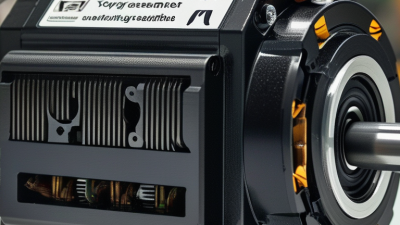
How to Choose an Electric Servo Motor in 2026?
Choosing an electric servo motor in 2026 requires more than comparing rated power or purchase price. The correct choice begins with the machine’s real movement profile: acceleration, deceleration, peak torque, continuous load, speed range, and operating cycle. A motor lifting a 20-kilogram axis behaves differently from one driving a lightweight pick-and-place arm.
Peter Nachtwey, a respected motion-control engineer, has said, “A servo system is only as good as its feedback and tuning.” That warning remains practical. A high-resolution encoder cannot rescue poor mechanical design, excessive backlash, or an incorrectly sized amplifier. The outline will examine motor torque, inertia matching, encoder technology, drive compatibility, thermal performance, communication protocols, and functional safety. It will also consider maintenance access, environmental conditions, and the total cost of ownership.
Small details matter. A warm gearbox, a vibrating coupling, or a cable routed beside noisy power lines can change performance. It is tempting to select extra capacity for comfort, but oversizing may reduce efficiency and control quality. That assumption can fail.
The guide will compare common selection approaches for robotics, packaging equipment, CNC machinery, and automated assembly. It will explain where brushless AC designs fit, when integrated servos may simplify installation, and why feedback resolution should match the application rather than marketing claims. Some recommendations will remain cautious. Real machines rarely behave perfectly, and laboratory figures may not survive dust, heat, or years of production. A reliable decision therefore combines calculations, supplier documentation, hands-on testing, and honest review of operating conditions.

Define the Motion Requirements for Your Application
Choosing an electric servo motor begins with defining the machine’s actual motion requirements. Do not guess. Measure the real load, travel distance, cycle time, and stopping position. Record both continuous speed and peak speed, because they can differ sharply during acceleration.
Calculate the required torque from load mass, friction, pulley radius, and acceleration. Include reflected inertia from gears, couplings, and screws. A vertical axis also needs attention to gravity and possible holding requirements. Peak torque matters during rapid starts, while continuous torque affects motor heating over long cycles. I have seen early designs fail because the average load looked harmless.
Positioning accuracy needs a practical tolerance, not an impressive number copied from a catalog. Consider backlash, frame flexibility, vibration, and encoder resolution. A clean laboratory test may not represent a dusty production line. Temperature, duty cycle, shock, and available installation space should shape the selection. Leave some capacity for wear and process variation, but avoid excessive oversizing. A larger motor may respond slowly, cost more, and waste energy. Recheck every assumption against measured data before finalizing the motion profile.
Compare Servo Motor Types, Torque, Speed, and Duty Ratings
How to Choose an Electric Servo Motor in 2026?
Compare Servo Motor Types, Torque, Speed, and Duty Ratings
When selecting a servo motor, start with the load profile, not catalog horsepower. A 12 N·m continuous requirement may hide 30 N·m acceleration peaks. Size for RMS torque, peak torque, and reflected inertia. Keep a margin, but avoid oversizing; excessive capacity can reduce responsiveness and efficiency. In field commissioning, I check the torque trace after tuning. The spreadsheet is rarely the whole machine.
For rotary axes, AC synchronous servo motors suit precise positioning and repeated reversals. Brushless DC options can simplify smaller, cost-sensitive axes, though feedback and thermal limits still matter. Linear servo motors remove screw backlash and deliver direct motion, but exposed magnets require careful guarding. Speed changes the choice: calculate torque at the actual operating speed, then inspect the drive’s speed-torque curve. A 3,000 rpm rating does not guarantee useful torque at 3,000 rpm.
Duty rating deserves equal weight. IEC 60034-1 classes S1, S3, and S6 describe continuous, intermittent, and periodic operation. Match the class to stops, dwell time, and cooling. IFR’s World Robotics 2024 recorded 541,302 industrial robot installations in 2023, showing how many servo axes face demanding cycles. Meanwhile, the IEA’s Energy Efficiency 2023 report places industry near 37% of global final energy use. Therefore, regenerative braking, standby losses, and thermal rise deserve measurement. I would validate performance with a thermal camera and ten-minute peak cycles. Not assumptions. That is slower, but safer.
| Servo Motor Type | Typical Motor Construction | Typical Continuous Torque Range | Typical Peak Torque | Typical Speed Range | Duty Rating | Key Advantages | Typical Applications |
|---|---|---|---|---|---|---|---|
| Permanent-Magnet AC Servo | Three-phase synchronous motor with permanent magnets and electronic commutation | 0.1–100 N·m for common machine-axis sizes | Approximately 200–300% of rated torque for short acceleration periods | 2,000–6,000 rpm; some designs operate above 6,000 rpm | Continuous S1 | High efficiency, accurate positioning, strong dynamic response, and compact size | Packaging machinery, CNC feed axes, robotics, printing equipment, and automated assembly |
| Brushless DC Servo | Permanent-magnet rotor with electronic commutation; commonly optimized for compact motion systems | 0.02–20 N·m | Approximately 150–250% of rated torque, depending on the drive and thermal limits | 2,000–10,000 rpm; application-specific | Continuous S1 | Low maintenance, good efficiency, low rotor inertia, and suitable for frequent speed changes | Small automation equipment, medical mechanisms, laboratory systems, and mobile machinery |
| AC Induction Servo | Squirrel-cage induction motor controlled by a closed-loop variable-frequency drive | 1–500 N·m and above in larger industrial packages | Approximately 150–200% of rated torque, depending on the control system | Typically 1,000–3,600 rpm; higher speeds require appropriate motor design | Continuous S1 | Rugged construction, good overload capability, and broad availability in higher power ranges | Conveyors, machine tools, hoists, pumps, fans, and high-power industrial axes |
| Linear Servo Motor | Linear version of a synchronous motor that produces direct electromagnetic thrust | Specified as continuous force: 50–5,000 N | Approximately 200–300% of continuous force for short-duration acceleration | 0.5–5 m/s; specialized systems may exceed this range | Continuous S1 | Direct linear motion, no ballscrew backlash, high acceleration, and excellent repeatability | Semiconductor equipment, high-speed pick-and-place systems, inspection stages, and precision machine tools |
| Hollow-Shaft Servo | Servo motor with a through-bore that allows cables, shafts, or tooling to pass through the rotor | 0.5–50 N·m | Approximately 200–300% of rated torque | 1,000–4,000 rpm | Continuous S1 | Space-saving integration, simplified cable routing, and reduced mechanical packaging complexity | Rotary indexing tables, robot joints, cable-driven tooling, and compact automation modules |
Selection note: Confirm the required continuous torque, peak torque, operating speed, acceleration time, ambient temperature, mounting orientation, and load inertia. The ranges above are representative engineering values rather than universal limits; the motor, drive, gearbox, and thermal conditions must be evaluated as a complete system.
Match the Motor with Its Drive, Controller, and Feedback System
How to Choose an Electric Servo Motor in 2026?
Match the motor with its drive, controller, and feedback system before comparing rated power. Start with the machine’s motion profile. Record acceleration, deceleration, dwell time, peak torque, and continuous torque. A motor that survives peak load may still overheat during repeated cycles.
Check the drive’s voltage, current, regeneration capacity, and supported commutation method. The controller must exchange position and velocity data at a suitable update rate. Feedback compatibility matters just as much. An absolute encoder can simplify machine recovery after power loss, while a high-resolution incremental encoder may suit a simpler axis. Confirm connector wiring, signal levels, communication protocol, and cable length from the datasheets.
Do not ignore inertia. Poor load matching can create vibration, overshoot, or slow tuning. Calculate the reflected load inertia, then test the ratio under real acceleration conditions. Thermal curves are more useful than a single power rating. Leave practical margin, but avoid oversized motors that reduce efficiency and tuning sensitivity.
Small details matter.
During commissioning, observe following error, motor temperature, acoustic noise, and regeneration alarms. These signals often reveal a mismatch that calculations miss. A neat spreadsheet cannot replace a measured motion profile. One assumption may be wrong. Recheck it. Also consider encoder resolution, brake requirements, environmental sealing, and maintenance access. A technically compatible system can still become difficult to service when feedback cables are too short or poorly routed.
Check Mechanical Fit, Power Needs, and Operating Environment
How to Choose an Electric Servo Motor in 2026?
Mechanical fit should be checked before comparing rated power. Measure shaft diameter, keyway, flange pattern, mounting depth, and brake clearance. Confirm allowable radial and axial loads. A small mismatch can cause coupling wear, noise, or early bearing failure. In practical design reviews, cable routing is often forgotten. That detail matters.
Power selection needs more than a peak torque number. Map the real torque-speed curve, acceleration time, duty cycle, inertia ratio, and load changes. The U.S. Department of Energy’s Improving Motor and Drive System Performance Sourcebook estimates that motor systems consume about 68% of industrial electricity in the United States. The IEA’s Energy Efficiency 2023 report also places industry near 40% of global final energy use. These figures are broad, not servo-specific. Still, they show why poor sizing deserves attention. An oversized motor may waste energy and reduce control quality.
Operating conditions can quietly change the specification. Record ambient temperature, humidity, dust, vibration, altitude, washdown exposure, and chemical contact. IEC 60034-5 and IEC 60529 help define enclosure protection, but an IP rating does not guarantee corrosion resistance. IP65 may handle dust and water jets, yet fail under continuous immersion or aggressive cleaners. Check thermal derating curves and connector limits. ISO 20816 vibration guidance is useful for rotating equipment, although actual machine resonance may be worse. A laboratory fit is not always a factory fit.
How to Choose an Electric Servo Motor in 2026?
Check mechanical fit, power needs, and operating environment before selecting a servo motor.
Confirm flange dimensions, shaft diameter, keyway or coupling type, mounting orientation, allowable radial load, and rotor inertia compatibility.
Mechanical power is calculated from torque and speed using P(kW) = torque(N·m) × speed(rpm) ÷ 9550. Include acceleration torque and a suitable service margin.
Check ambient temperature, humidity, dust, washdown exposure, vibration, altitude, and the required enclosure protection level under IEC 60529.
The chart shows calculated continuous mechanical power for representative torque-speed operating points. Actual motor selection must also verify peak torque, duty cycle, thermal limits, drive compatibility, and installation dimensions.
Evaluate Precision, Safety, Maintenance, and Total Cost
How to Choose an Electric Servo Motor in 2026?
Precision should start with the load, not the catalog. Measure inertia, peak torque, speed range, backlash, and settling time. A servo reaching rated accuracy under light load may disappoint on the production floor. Encoder resolution matters, but it is not the entire decision. The International Federation of Robotics reported 541,302 industrial robots installed worldwide in 2023 in World Robotics 2024. That growth creates tighter cycle and repeatability demands. Test the motor with the actual gearbox, cable length, payload, and thermal duty.
Safety needs a separate review. Check safe torque off, braking behavior, fault diagnostics, guarding, and the required performance level under ISO 13849-1:2023. Do not treat safety as a software checkbox. A stopped shaft can still coast. Document stopping time and residual movement. This is where a rushed selection becomes expensive.
Maintenance and total cost deserve equal weight. The U.S. Department of Energy estimates motor systems use about 70% of electricity in manufacturing. Efficiency affects every operating hour. Compare standby power, regenerative handling, bearing life, spare-part access, commissioning time, and technician training. Include downtime. A low purchase price may hide difficult tuning or costly repairs. I would challenge every payback model with worst-case duty, not average duty. That may seem overly cautious. It is still cheaper than discovering the gap after installation.
Related Posts
-
How to Choose the Right Small Servo Motor for Your Application?
-
Top Tips for Choosing the Right Integrated Servo Motor?
-
2025 Guide: How to Choose the Best Small Servo Motor for Your Robotics Project
-
How to Choose the Best High Torque Servo for Your Applications in 2025
-
Top 10 Tips for Choosing an Integrated Servo Motor?
-

What is an AC Servo Motor and How Does it Work?