Why Choose Gate Valves for Your Industrial Needs?
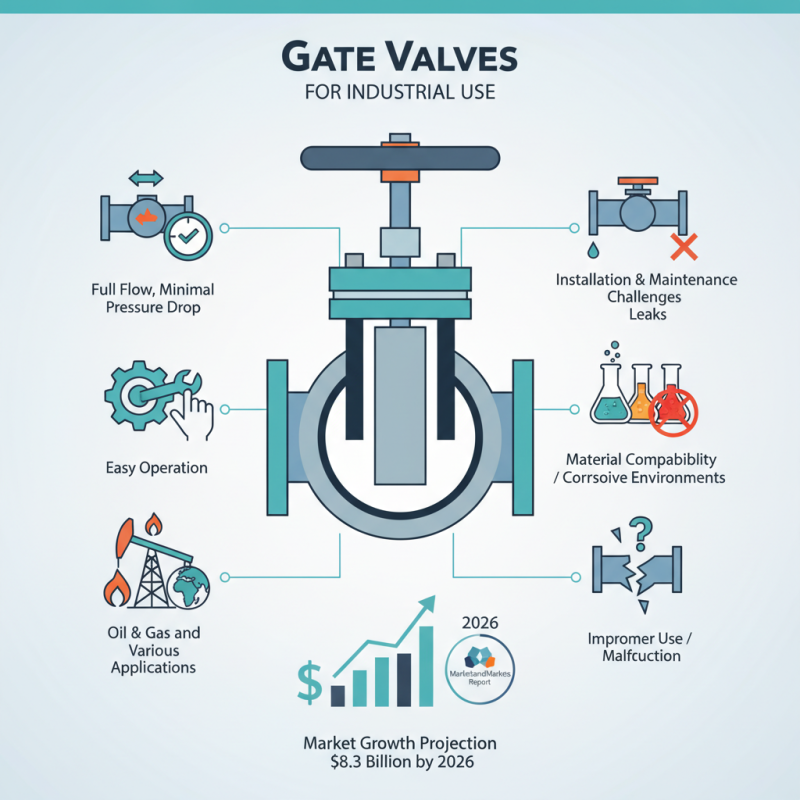
In today's industrial landscape, choosing the right components is crucial for efficiency and safety. Gate Valves are a primary choice for various applications due to their reliability and performance. According to a recent industry report by MarketsandMarkets, the gate valve market is projected to reach $8.3 billion by 2026, reflecting their vital role.
Gate valves provide full flow with minimal pressure drop. This is essential in applications like oil and gas, where even minor losses can lead to significant issues. Their design allows for easy operation, making them favorable in facilities needing frequent adjustments. However, it is important to consider installation and maintenance challenges. Poor handling can lead to leaks, which might compromise system integrity.
Selecting gate valves also requires understanding material compatibility with different media. Not all gate valves perform equally in corrosive environments. Furthermore, while they can be efficient, improper use may cause malfunction. Industry experts recommend thorough research and consultations before making a decision.
Understanding Gate Valves: Structure and Functionality
Gate valves are a pivotal component in industrial applications. Understanding their structure and functionality can illuminate their significance. Gate valves are designed to allow or restrict flow in a pipeline. Their primary characteristic is a gate mechanism that fully opens or closes. When fully opened, the flow path is unobstructed, ensuring minimal turbulence. This makes them ideal for applications requiring a straight-line fluid flow.
The structure of a gate valve includes a body, bonnet, and gate. Typically, they are made from materials like stainless steel or ductile iron. A report by the Valve Manufacturers Association highlights that gate valves are preferred in over 30% of industrial systems. This preference stems from their ability to handle high pressure and temperature. However, they may not perform well in throttling applications. Due to their design, they can cause wear and tear in some scenarios.
Understanding safety and maintenance is crucial. Regular inspection can help identify potential leaks or malfunctions. A study from the International Journal of Industrial Mechanics shows that improper operation can shorten a valve's lifespan by up to 40%. This emphasizes the need for trained personnel to operate and maintain these components effectively.
Advantages of Gate Valves in Industrial Applications
Gate valves have become a staple in industrial applications due to their numerous advantages. One significant benefit is their ability to maintain a tight seal when fully closed. This feature minimizes leaks, which is crucial in industries that handle hazardous materials. According to a report from the American Society of Mechanical Engineers (ASME), gate valves are preferred in 70% of high-pressure applications, highlighting their reliability in demanding environments.
Another important advantage of gate valves is their low-pressure drop. When fully open, they provide minimal resistance to the flow of liquids or gases. A study by the Valve Manufacturers Association found that gate valves can reduce pressure loss by as much as 25% compared to other valve types. This can lead to enhanced efficiency in systems that operate continuously, ultimately saving energy and reducing operational costs. However, the installation process can sometimes be complex, which could lead to operational challenges.
Durability is a further reason why gate valves are widely used. They are built to withstand extreme conditions, including high temperatures and corrosive environments. The International Journal of Industrial Engineering reports that with proper maintenance, gate valves can last up to 30 years. Still, industries need to be cautious. Regular checks are necessary to avoid premature failures, which could result in costly downtime. While gate valves provide many benefits, their effectiveness depends on proper installation and maintenance practices.
Why Choose Gate Valves for Your Industrial Needs? - Advantages of Gate Valves in Industrial Applications
| Feature | Description | Benefits |
| Design | Gate valves have a linear motion and are designed to allow or block flow of liquids or gases. | Provides effective shut-off capability and low flow resistance. |
| Durability | Constructed with robust materials to withstand high pressure and temperature. | Long service life and reduced maintenance costs. |
| Fluid Types | Compatible with a wide range of fluids, including water, oil, and gas. | Versatile for different industrial applications. |
| Flow Direction | Designed for unidirectional and bidirectional flow control. | Enhances flexibility in piping layouts. |
| Maintenance | Easy to maintain due to their simple design and fewer moving parts. | Cost-effective and minimizes downtime. |
Common Materials Used in Gate Valve Manufacturing
Gate valves are essential in industrial applications. Choosing the right material is crucial for their performance and durability. Common materials used in gate valve manufacturing include cast iron, stainless steel, and brass. Each material serves specific needs and environments.
Cast iron is cost-effective and strong. It is ideal for low-pressure applications. However, it can be prone to corrosion if not properly coated. Stainless steel offers excellent corrosion resistance. It is suitable for more demanding environments, including those with high temperatures. Yet, its higher cost can be a consideration for some projects.
Brass is another popular choice. It is durable and easy to machine. Also, it performs well in low-pressure scenarios. Nevertheless, brass can react with certain fluids. This reaction may require careful consideration in its application. Selecting the right material is vital for ensuring optimal efficiency and lifetime of gate valves. Each option has strengths and weaknesses that need reflection.
Key Considerations for Selecting Gate Valves
When selecting gate valves for industrial applications, several key factors come into play. One important aspect is the material used in the valve’s construction. Different environments may demand various materials, such as stainless steel or ductile iron. Choosing the right material helps prevent corrosion and extends the valve's lifespan.
Another essential consideration is the valve size and pressure ratings. Oversizing or undersizing a valve can lead to operational issues. It’s crucial to match the valve dimensions with the pipeline requirements. A mismatch may cause a decrease in flow efficiency or even system failures in extreme cases.
One often overlooked factor is maintenance accessibility. Gate valves may be positioned in tight spaces, making maintenance challenging. Regular inspection is vital, yet hard-to-access valves can deter routine checks. This reality raises questions about long-term reliability and the potential for costly downtime. Always consider these factors to enhance system performance and reliability.
Maintenance Practices for Optimal Gate Valve Performance
Maintenance is crucial for the effective performance of gate valves in industrial settings. Regular inspections help identify signs of wear, corrosion, or leakage. According to industry reports, up to 30% of valve failures are linked to improper maintenance practices. To prevent this, a systematic maintenance schedule should be established.
Routine checks should include examining the seating surfaces for damage. These surfaces must remain smooth and free from debris. Inadequate sealing affects performance and can lead to pressure loss. Furthermore, lubrication is essential. It affects not only the operation but also the lifespan of the valve. Based on engineering studies, proper lubrication can extend valve life by up to 25%.
It is important to document all maintenance activities. Keeping a log aids in identifying recurring issues. Furthermore, training personnel on best practices enhances reliability. A well-maintained gate valve operates efficiently and reduces downtime. However, ignoring maintenance can result in costly repairs. Regular attention ensures that gate valves meet operational standards and function optimally in demanding environments.
Gate Valve Performance and Maintenance Practices
