
China Top Linear Wall Lamp Manufacturer for Global Buyers?

Choosing a China Top Linear Wall Lamp Manufacturer for Global Buyers requires more than comparing catalog prices. The right partner must combine optical knowledge, stable production, careful material selection, and dependable communication. A Linear Wall Lamp should create an even visual rhythm, not bright spots across the wall. Its aluminum body should feel rigid in the hand. Its diffuser should soften glare without making the light look dull.

Lighting specialist Jonathan Speirs once said, “Light is not just something we see; it is something that shapes how we experience space.” That principle matters when evaluating Chinese manufacturers. A capable factory studies beam angles, color consistency, heat control, driver performance, and installation conditions. It also understands that a hotel corridor needs different visual comfort from a private residence or retail showroom.

Details reveal experience. Ask for photometric files, color tolerance data, aging tests, and samples with the final driver. Check whether the manufacturer can manage custom lengths, wall finishes, dimming systems, and international packaging. Production photographs help, but they are not proof of quality. Independent inspection can expose uneven anodizing, loose terminals, or inconsistent LED modules.

No manufacturer is perfect. Even experienced suppliers may face delays during peak seasons or struggle with unusual customization. That is worth acknowledging. A reliable supplier responds clearly, documents corrective actions, and accepts reasonable testing. Global buyers should examine the factory’s communication, not only its product photos. The best Linear Wall Lamp partner offers a practical balance of design flexibility, technical control, transparent pricing, and long-term service. That balance is harder to find than a polished brochure.
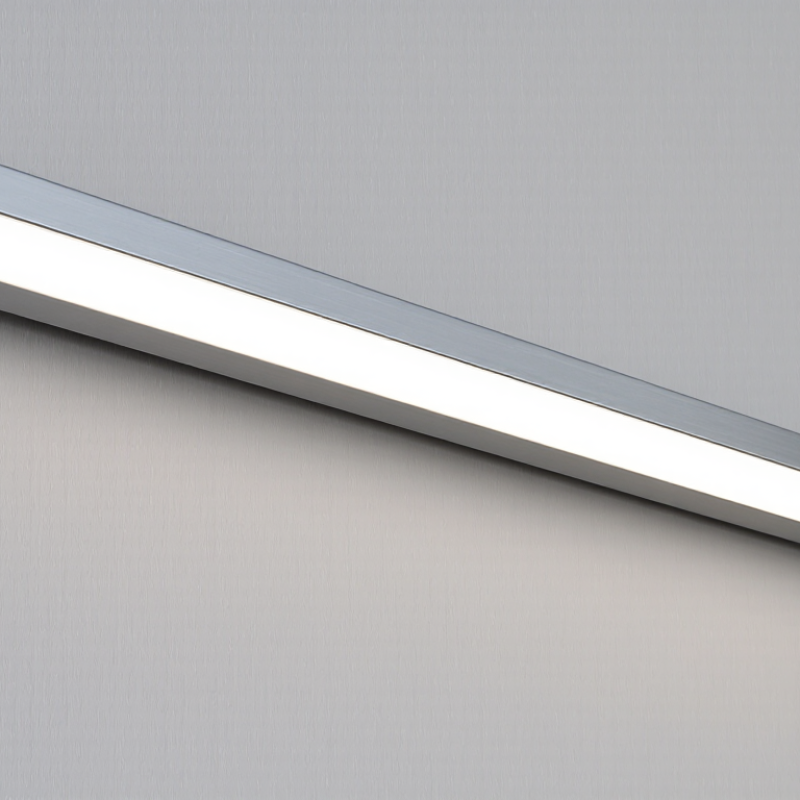
China Top Linear Wall Lamp Manufacturer for Global Buyers?

Linear Wall Lamp Market Scope: LED Efficiency Above 100 lm/W and Global Demand

For global buyers, linear wall lamps are no longer judged by shape alone. The market is moving toward LED systems delivering above 100 lm/W, measured at the complete fixture level. This distinction matters. Some catalogs quote LED chip efficiency, not real output after lenses, drivers, and heat loss. In factory evaluations, I check integrating-sphere reports, driver data, and thermal performance together. A slim aluminum housing should stay touch-safe during extended operation.

Demand varies by project. Hotels often need warm 2700–3000 K light, low glare, and quiet dimming. Offices may request 3500–4000 K, higher visual comfort, and stable output across long corridors. Exterior installations add moisture resistance, UV exposure, and secure mounting details. Above 100 lm/W can reduce energy use, but only when light is aimed correctly. A bright fixture can still waste light.

Reliable suppliers provide photometric files, color-tolerance data, sample approvals, and traceable production records. Buyers should test a pilot batch before committing to large volumes. I have seen efficient samples perform poorly after repeated thermal cycles. That warning deserves attention. Efficiency also depends on ambient temperature, driver quality, and cleaning conditions. A manufacturer serving global markets should explain these limits clearly, rather than promise one number for every application.

China Top Linear Wall Lamp Manufacturer for Global Buyers?

Linear Wall Lamp Market Scope: LED Efficiency Above 100 lm/W and Global Demand

LED luminaires exceeding 100 lm/W are widely positioned as an efficiency benchmark for commercial, hospitality, residential, and outdoor linear wall-lighting applications. Higher efficacy can reduce energy consumption, support longer operating hours, and improve suitability for global energy-efficiency requirements. The values shown are representative application benchmarks based on public LED lighting performance guidance from the U.S. Department of Energy and regional ecodesign requirements.

Reference: U.S. Department of Energy, Solid-State Lighting R&D and product-performance guidance; European Commission Ecodesign requirements for light sources.

China’s Manufacturing Base: OEM Capacity, Export Scale, and Supply-Chain Depth

China has become a major manufacturing base for linear wall lamps, supported by mature lighting clusters and export-oriented factories. Its OEM capacity covers housing design, LED modules, finishes, packaging, and control options. An experienced supplier can adjust beam angles, color temperatures, mounting plates, and carton sizes for different projects. That flexibility matters.

Export scale also shapes factory discipline. Suppliers serving overseas buyers usually understand production schedules, inspection records, shipping documents, and protective packaging. In practical sourcing work, these details often separate a smooth order from an expensive delay. A sample may look excellent, yet the real test is consistent performance across hundreds of units. Small gaps appear here.

Supply-chain depth is another advantage. Aluminum profiles, drivers, diffusers, fasteners, and powder-coating services are often available within connected regional networks. This can shorten development cycles and reduce dependence on one workshop. However, deeper supply chains do not guarantee perfect control. A rushed audit may miss subcontracted finishing or changing component sources. Buyers should verify material specifications, electrical testing, batch records, and final inspection photos before shipment. These checks may feel repetitive. They are useful. A capable manufacturer should answer clearly, provide traceable evidence, and accept reasonable design revisions without hiding limitations.

Product Standards Explained: IEC 60598-1, CE, RoHS, and IP44–IP65 Ratings

China Top Linear Wall Lamp Manufacturer for Global Buyers?

For global buyers, product standards are practical checkpoints, not decorative paperwork. IEC 60598-1 covers general safety requirements for luminaires, including insulation, wiring, temperature, mechanical strength, and markings. Our production inspections check terminal tightness, cable routing, and heat around the LED driver. Small details matter.

CE indicates conformity with applicable European requirements. It is supported by technical documentation and a Declaration of Conformity. It is not a quality award. RoHS controls restricted substances in electrical and electronic products. Buyers should request material declarations, test evidence, and clear production traceability. A copied certificate is not enough.

IP ratings describe protection against solids and water. IP44 resists objects above one millimeter and splashing water. IP65 is dust-tight and resists low-pressure water jets. That difference affects bathrooms, covered corridors, facades, and exposed entrances. However, IP65 does not automatically prove UV resistance, salt-spray protection, or long outdoor life. The housing, gasket, cable gland, and installation surface must work together. No certificate replaces a poor seal. In real inspections, uneven gasket compression can appear after assembly, even when a sample passed testing. This is where careful review is still needed.

Buyer Evaluation Metrics: CRI 80+, 50,000-Hour Life, and 5-Year Warranty

For global buyers, a linear wall lamp should be judged by verified performance, not polished photographs. CRI 80+ provides dependable color rendering for corridors, hotels, offices, and residential spaces. However, CRI can vary across LED batches. Ask for current test reports, not old samples.

A claimed 50,000-hour life sounds reassuring, but operating conditions matter. Review the LED temperature, driver quality, lumen-maintenance data, and test method. In a real installation, poor ventilation can reduce service life. Check whether the rating refers to L70 performance or a simple marketing estimate. Small details matter.

A five-year warranty also needs careful reading. Confirm coverage for the LED board, driver, housing, and finish. Ask about replacement procedures, response times, and installation exclusions. Keep product codes and purchase records. This is practical experience, not paperwork for its own sake. Some suppliers provide strong numbers but weak after-sales support. That gap deserves scrutiny. A reliable manufacturer should share technical files, inspection records, and consistent sample results. Still, buyers should test a production sample before placing a large order. Metrics guide the decision. They do not replace judgment.

China Top Linear Wall Lamp Manufacturer for Global Buyers? - Buyer Evaluation Metrics: CRI 80+, 50,000-Hour Life, and 5-Year Warranty

Evaluation Dimension Recommended Buyer Benchmark Why It Matters Evidence to Request Pass Standard
Color Rendering Index (CRI) CRI ≥ 80 for general applications; CRI ≥ 90 for retail, hospitality, galleries, and premium interiors Higher CRI produces more natural and accurate color appearance under the lamp. Independent photometric report or LM-79 test report showing Ra/CRI results. Declared CRI is supported by test documentation and matches the ordered specification.
LED Rated Life L70 ≥ 50,000 hours, preferably with a stated ambient-temperature condition L70 indicates the estimated time until LED light output decreases to approximately 70% of its initial level. LED manufacturer data sheet, LM-80 data, TM-21 projection, or complete luminaire life report. The life claim identifies the lumen-maintenance method and operating conditions.
Warranty Coverage 5-year limited warranty for the complete luminaire A clear warranty reduces replacement risk for commercial projects and distributors. Signed warranty document covering LED modules, driver, housing, and workmanship. Warranty period, exclusions, remedy, and claim procedure are stated in writing.
Luminous Efficacy Approximately 90–130 lm/W for a complete indoor linear wall luminaire, depending on optics and diffuser Higher system efficacy can reduce energy consumption while maintaining the required illuminance. Photometric test report listing input power, delivered lumens, and efficacy. Evaluate complete-luminaire performance rather than LED-chip efficacy alone.
Color Temperature Common options: 2700K, 3000K, 3500K, 4000K, and 5000K Color temperature affects visual comfort, atmosphere, and suitability for different spaces. Product specification sheet and sample confirmation with measured CCT and tolerance. Delivered CCT is within the agreed tolerance, commonly within ±200K for general products.
Color Consistency MacAdam 3-step or 5-step binning, subject to the project requirement Tighter color consistency helps prevent visible color differences between adjacent fixtures. LED binning statement and color-consistency specification. The same binning requirement is applied to the production batch.
Input Voltage and Frequency 100–277V AC or 220–240V AC, 50/60Hz, according to the destination market Correct electrical compatibility supports safe installation and stable operation. Driver label, electrical test report, and installation instructions. Rated input range matches the project’s local electrical supply.
Power Factor and THD Power factor ≥ 0.90; total harmonic distortion preferably ≤ 20% Good power quality can reduce electrical losses and support commercial lighting compliance. Driver data sheet or electrical test report under the specified input condition. Values are verified at the actual rated load, not only at no-load conditions.
Ingress Protection IP20 for dry indoor areas; IP44 or higher where protection from splashing is required Ingress protection should match the installation environment and cleaning conditions. IP test report or certification for the complete assembled luminaire. The IP rating is appropriate for the intended location and installation orientation.
Thermal Management Aluminum heat sink or thermally effective housing with documented operating-temperature limits Effective heat dissipation supports lumen maintenance, driver reliability, and service life. Thermal test results, housing material specification, and maximum ambient-temperature rating. The luminaire remains within the stated temperature limits at full rated power.
Dimming and Control Compatibility Non-dimmable, 0–10V, DALI, or other control options clearly identified before ordering Control compatibility affects energy management and integration with building systems. Wiring diagram, driver model specification, and dimming test sample. The selected driver and control protocol operate without flicker or abnormal noise.
Flicker Performance Low-flicker driver suitable for the application; exact limits should be documented Reduced flicker improves visual comfort and is important for camera-recorded or task-focused spaces. Flicker test data such as percent flicker and flicker index, or equivalent measurement. Performance meets the buyer’s project, workplace, or regional lighting requirements.
Safety and EMC Compliance Applicable requirements for the destination market, such as electrical safety and electromagnetic compatibility Compliance documentation supports customs clearance, project approval, and safe operation. Valid test reports or certificates issued for the relevant product configuration. Documents identify the same model, driver, voltage, and configuration being purchased.
Mechanical Construction Rigid aluminum housing, secure end caps, reliable mounting hardware, and a replaceable or serviceable driver where practical Construction quality affects installation efficiency, durability, and maintenance cost. Material specification, assembly drawings, sample inspection, and drop or vibration requirements where applicable. The sample matches the approved drawing and withstands normal handling and installation.
Quality Control and Batch Consistency Documented incoming inspection, production testing, aging test, and final inspection Repeatable processes help maintain consistent color, output, electrical safety, and workmanship across shipments. Quality-control plan, inspection checklist, sample test records, and pre-shipment inspection option. Critical specifications are checked and recorded for each production batch.
Packaging and Export Readiness Impact-resistant inner protection, moisture protection where required, clear carton markings, and export documentation Proper packaging reduces transit damage and supports efficient receiving and inventory control. Packaging specification, carton dimensions, packing photos, and shipping-document checklist. Packaging is validated with a production-equivalent sample before mass shipment.

Buyer note: Final acceptance values should be confirmed against the destination market, project specifications, applicable regulations, and the exact luminaire configuration.

Supplier Selection Process: Samples, Certifications, MOQ, Lead Time, and QC Data

China Top Linear Wall Lamp Manufacturer for Global Buyers?

Selecting a linear wall lamp supplier requires evidence, not polished promises. Request two samples from the same production batch. Check the aluminum finish, diffuser uniformity, cable length, mounting plate, and screw alignment. Test the lamp for flicker, color temperature, CRI, brightness, and heat after several hours. A perfect sample can still hide unstable production.

Ask for relevant certification copies and matching test reports. Check the model number, electrical rating, laboratory details, and report dates. Common documents may include CE, RoHS, EMC, or LVD records, depending on the destination market. Do not accept a certificate without traceable product information. We once treated a document as sufficient, but its listed model differed from the sample. That mistake delayed approval.

Confirm MOQ in writing, including sample quantities and mixed finishes. A supplier offering 100 pieces may require separate MOQs for black, white, and custom colors. Request a realistic lead time covering material purchasing, assembly, aging tests, and packing. Forty-five days may sound safe, yet imported drivers can create delays. Review QC data, not only inspection photos. Useful records include incoming material checks, wiring tests, eight-hour aging results, lumen output, CCT, and carton drop tests. Keep a signed pre-shipment inspection standard. It feels slower, but vague acceptance criteria usually cost more later.