
2026 Best Hair Restoration Methods for Global Buyers
Hair Restoration is entering 2026 with more choices, but not necessarily clearer answers. Global buyers can compare follicular unit transplantation, follicular unit extraction, medical therapy, low-level light therapy, and regenerative treatments. Each option has different evidence, costs, recovery times, and regulatory status. The best method depends on diagnosis, donor density, age, and long-term hair-loss patterns.
The International Society of Hair Restoration Surgery’s 2022 Practice Census reported 3,421,005 hair-restoration patients worldwide in 2021. That figure shows strong demand, but it does not prove that every procedure works equally well. Grand View Research’s market analysis also identifies growing interest in minimally invasive solutions. Forecasts remain estimates. They should not replace clinical judgment.
“There is no one-size-fits-all approach to hair loss,” says Dr. Bessam Farjo, a former International Society of Hair Restoration Surgery president and experienced hair-restoration surgeon. His point matters for international buyers. A clinic’s impressive website cannot reveal graft survival, donor-area planning, or follow-up quality. Ask for diagnosis, surgeon credentials, complication rates, and realistic before-and-after cases. Confirm whether medicines are legally approved in your country.
Some claims deserve skepticism. PRP results remain inconsistent across studies. “Natural” does not automatically mean safe. A low price may hide limited aftercare, unclear licensing, or aggressive graft extraction. Good Hair Restoration planning should feel measured, not rushed. This guide compares leading methods through clinical evidence, practical experience, regulatory awareness, and buyer protection. Mistakes still happen. That is why informed caution remains part of the treatment.
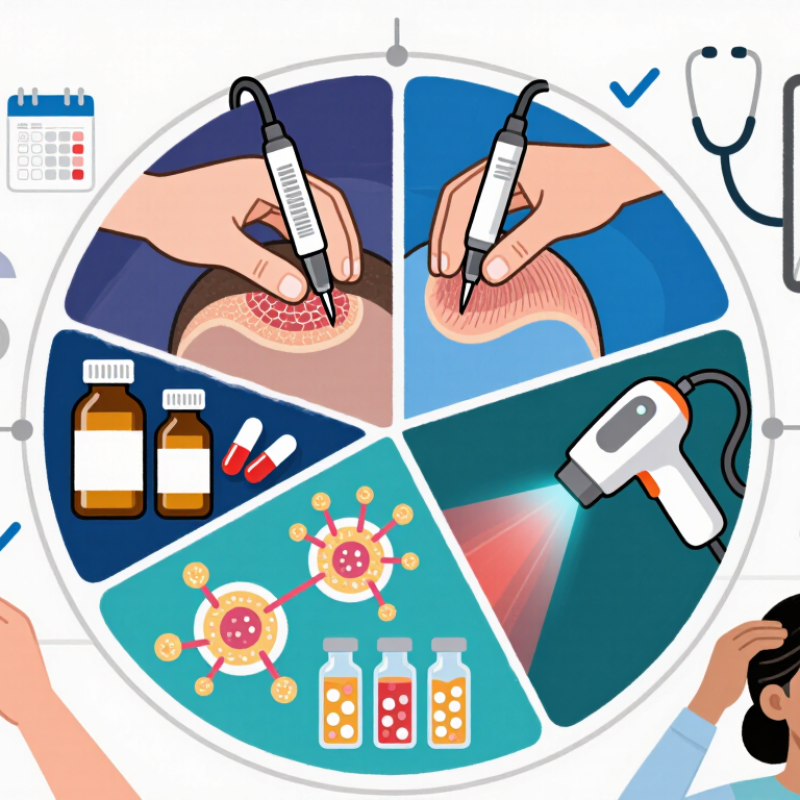
Hair Restoration: Definition, Goals, and Candidate Assessment
Hair restoration is the medical effort to improve visible hair loss. It may involve follicle transplantation, medication, or supportive scalp treatments. The goal is not simply maximum density. A natural hairline, stronger coverage, and realistic long-term maintenance matter more. Results depend on diagnosis, timing, and the quality of available donor hair.
Candidate assessment should begin with a qualified medical consultation. The clinician should review family history, shedding patterns, previous illnesses, medications, and scalp symptoms. A close scalp examination can reveal miniaturized follicles, inflammation, scarring, or uneven density. Standardized photographs under consistent lighting help track change. They also reduce memory-based judgments.
Not every case qualifies.
A suitable candidate usually has a stable donor area and a clear treatment objective. Someone with sudden shedding may need diagnostic testing before considering a procedure. Expectations require honest discussion, especially when the crown is thin or donor supply is limited. Age alone should not decide eligibility. A younger buyer may need a conservative plan because future loss remains possible. That point is easy to overlook.
Assessment is not perfectly predictable. Hair cycles vary, and early progress can look disappointing. A careful provider should explain risks, recovery, possible revisions, and maintenance needs without promising certainty. Buyers should verify professional credentials and request evidence-based information before choosing among 2026 restoration methods.
| Method | How It Works | Typical Graft Capacity | Visible Recovery | Scarring Profile | Best-Suited Candidates | Main Limitations | Evidence & Practical Rating |
|---|---|---|---|---|---|---|---|
| FUE (Follicular Unit Excision) | Individual follicular units are removed from a donor area and placed into recipient sites. | Often about 1,000–3,000 grafts in one session; larger sessions depend on donor density, treatment time, and medical assessment. | Small crusts and redness commonly last about 7–14 days. Temporary shedding may occur several weeks after surgery. | Many small, round scars that are usually less noticeable than a linear scar when performed properly. | People seeking a linear-scar-free approach, including some short-hairstyle wearers with adequate donor supply. | Can overharvest the donor area; may take longer than strip surgery for large cases; results depend strongly on extraction and implantation technique. | ★★★★★ |
| FUT (Follicular Unit Transplantation) | A strip of hair-bearing skin is removed from the donor area, and follicular units are dissected for transplantation. | Commonly suitable for approximately 1,500–4,000 grafts, depending on scalp laxity and donor characteristics. | Incision healing generally takes around 10–14 days; soreness or tightness can persist longer in some patients. | Leaves a linear donor scar, which may be concealed by surrounding hair but can be visible with very short cuts. | People who may need a larger number of grafts and are comfortable maintaining enough donor-hair length to cover the scar. | Linear scarring, possible scalp tightness, and a longer incision-healing period than uncomplicated FUE. | ★★★★☆ |
| DHI (Direct Hair Implantation) | Usually refers to implantation of individually harvested grafts with an implanter device; it is generally a variation of FUE rather than a separate donor-harvesting method. | Frequently used for smaller or moderate sessions; capacity varies with graft quality, team skill, and operating time. | Often similar to FUE because graft harvesting still commonly uses an extraction technique; redness and crusting may last about 7–14 days. | Usually reflects the scarring pattern of the chosen extraction method, most often multiple small FUE scars. | Selected cases requiring detailed control of implant angle, direction, or density, after professional assessment. | The device does not guarantee better growth; it may increase procedure time and cost, and terminology is not standardized worldwide. | ★★★★☆ |
| Robotic-Assisted FUE | A computer-assisted system helps identify and extract selected follicular units; implantation is usually completed manually. | Varies by system, hair characteristics, and clinic protocol; it is generally used for selected FUE cases rather than every patient. | Comparable to FUE when extraction and aftercare are uncomplicated. | Multiple small extraction scars, similar to conventional FUE. | People with suitable hair color, curl pattern, donor density, and follicle visibility for the device being used. | Not appropriate for all hair types; availability is limited, and automation does not replace surgical planning or clinical judgment. | ★★★☆☆ |
| Non-Surgical Medical Therapy | May include clinically prescribed medicines or evidence-based light therapy intended to slow loss or support existing follicles; it does not transplant hair. | Not applicable; it preserves or stimulates existing follicles rather than adding donor grafts. | No surgical wound. Benefits generally require consistent, long-term use and periodic review. | No surgical scar. | People with early or ongoing pattern hair loss, especially when follicles remain miniaturized but viable. | Effectiveness varies; some treatments have contraindications or systemic side effects and should be discussed with a qualified clinician. | ★★★★☆ |
| Scalp Micropigmentation | Pigment is placed into the superficial scalp to simulate the appearance of shaved follicles or add visual density. | Not applicable; it creates an optical effect and does not grow hair. | Usually involves mild redness or sensitivity for a short period, with staged sessions often used for color and density adjustment. | Non-surgical; pigment can fade or change over time and may require maintenance. | People wanting the appearance of a closely shaved style or improved visual coverage without surgery. | Cannot restore hair growth; unsuitable pigment choice or poor design can look unnatural and may be difficult to correct. | ★★★☆☆ |
| Hair System or Prosthesis | A custom or ready-made hairpiece is attached with clips, adhesives, or other methods to create immediate coverage. | Not applicable; no follicles are transplanted. | Immediate cosmetic change, but regular fitting, cleaning, replacement, and scalp-care appointments are required. | No surgical scar. | People seeking immediate coverage or those who are not suitable for surgery or prefer a reversible option. | Ongoing maintenance cost, attachment concerns, heat or moisture management, and possible scalp irritation. | ★★★☆☆ |
Candidate assessment: A qualified clinician should confirm the cause of hair loss, stabilize progressive loss when appropriate, evaluate donor density and scalp health, review medical history and medications, set realistic density goals, and explain risks. Graft numbers, healing times, and outcomes vary by individual; transplanted hair does not prevent future loss in untreated native hair.